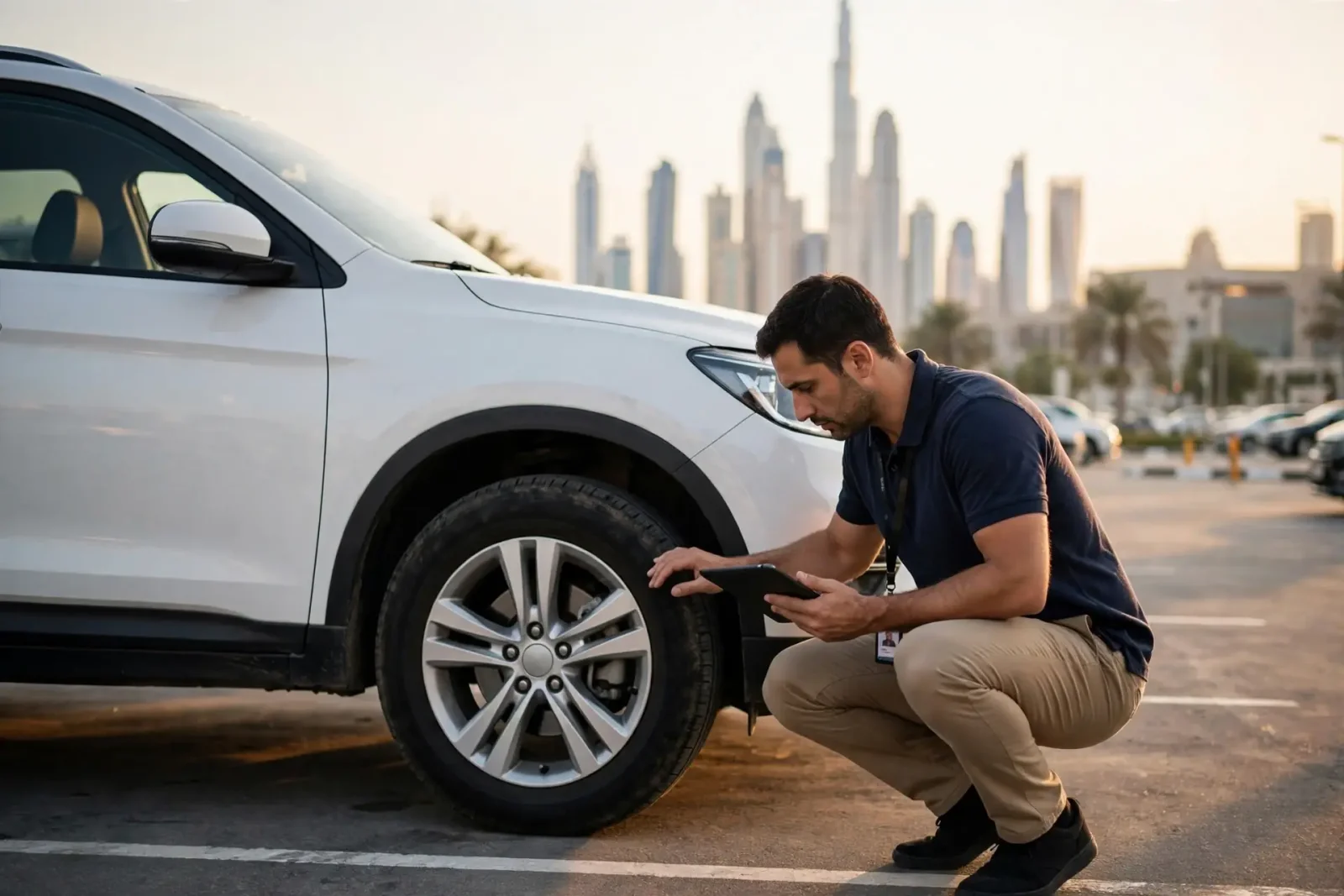
A rental car inspection checklist is a standardised walkaround that records a vehicle's condition before check-out and after check-in. It covers bodywork, glass, wheels and tyres, interior, lights, fluids and documentation, with photos and signatures. Done properly, it is the single document that decides who pays when damage is found.
Every rental operator has a version of the same story. The car comes back with a scraped bumper, the customer swears it was already there, and your paperwork says nothing either way. You absorb the repair cost, or you argue, or you charge the deposit and get a one-star review. All three outcomes trace back to the same failure: nobody recorded the car's condition properly.
This guide is the inspection process every operator should run from day one — written for the person doing the walkaround in the car park, not a compliance department. Follow it, and damage stops being a debate.
Why does every rental need an inspection?
Because without a signed condition record, every scratch becomes an argument. The inspection creates a timestamped baseline both parties agree to, which protects your revenue from unpaid damage and protects honest customers from being blamed for marks they didn't make. It is the cheapest insurance policy in the business.
A rental car changes hands dozens of times a year, driven by people with no attachment to it. Minor contact is normal — car park scrapes, kerbed wheels, stone chips. The question is never whether marks appear; it is whether you can prove which ones are new. Renters who walk the car with you and sign a form treat it better. The form takes ten minutes; the argument it prevents takes weeks.
When should you inspect a rental car?
At minimum twice: a check-out inspection with the customer present before the keys change hands, and a check-in inspection the moment the car comes back. Add a deeper weekly or monthly mechanical review for cars in continuous service, plus an inspection after any reported incident or long desert run.
The check-out inspection matters most. Walk the car with the customer, mark every blemish together, and get the signature before the keys move — a customer who pointed at the scratches won't dispute them later.
Inspect the moment the car returns, before it goes out again — damage found two rentals later is damage you cannot attribute. If staffing is tight, photograph the car on return and do the full comparison before the next check-out.
Cars on monthly contracts — common in the UAE corporate market — need a scheduled monthly review: tyres, fluids, fresh photos. Long hires hide slow damage.
What does the exterior inspection cover?
Every panel, bumper, mirror, light and glass surface, the wheels and tyres, and the roof. Work in the same order every time — front, driver's side, rear, passenger side, roof — and note every mark with its location and size. Consistency matters more than speed; a rushed walkaround misses the dent that costs you later.
- Work the same circuit every time so nothing gets skipped: front, driver's side, rear, passenger side, roof.
- Record precise location and size — “front bumper, lower left corner, scratch ~10 cm”. Vague notes like “scratch on bumper” are useless in a dispute.
- Distinguish wear from damage in writing. In the Gulf, fine dust marring on the bonnet and windscreen pitting from highway driving are normal life for a rental car — log them as wear so they are not charged for later.
- Check panel gaps and paint match — a bumper that doesn't match the wing signals a previous repair, and you want that recorded before a customer gets blamed for it.
- Don't forget the roof, mirrors and number plates — easy to miss, annoying to explain.
What does the interior inspection cover?
Seats, carpets, dashboard, headliner, boot and all controls, plus smell. Check for burns, stains, tears and missing items like the spare key, owner's manual or parcel shelf. Photograph the mileage and fuel level every time — fuel disputes are among the most common arguments at return, and a photo ends them instantly.
- Smell the car — smoke and heavy air-freshener both tell a story; note either.
- Check every seat, the headliner and the boot. Burns and stains are the classic deposit deductions — photograph them.
- Test what customers use: windows, locks, mirrors, infotainment, USB ports. A fault found mid-rental becomes your emergency.
- Confirm the spare key, owner's manual and accessories are present, and the boot holds the spare wheel and jack.
- Mileage and fuel, photographed every time. Agree the fuel policy up front — full-to-full is simplest — and write the level on the form.
What mechanical checks belong on the checklist?
Tyre condition and pressure including the spare, oil and coolant levels, brake feel, all lights and indicators, wipers and washers, horn, and air conditioning performance. These are safety items, not cosmetics — a soft tyre or weak AC in Gulf heat becomes a breakdown, a bad review, or worse, and the checklist is where you catch them.
Cosmetic checks protect revenue; mechanical checks protect reputation — a breakdown on Sheikh Zayed Road at noon in August is a review you never recover from.
- Tyres: tread depth, cuts, bulges, pressure — including the spare. Heat punishes weak sidewalls, so check them cold.
- Fluids: oil and coolant between the marks — an overheating engine in Gulf summer escalates fast.
- Air conditioning: run it for a minute. It must blow properly cold. If it doesn't, the car doesn't go out.
- Lights, indicators, wipers, washers, horn: five minutes on the lot, every time.
- Brakes: pedal feel and a short test roll before handover. Spongy pedal means the car stays parked.
How do you document damage so a claim holds up?
Photograph every existing mark from two angles, close-up and wide, with the number plate visible in at least one frame. Write the damage onto the inspection form with location and size, then get the customer to sign — on paper or digitally — before they drive away. No signature, no claim; unsigned forms lose disputes.
Paper forms get rained on, lost, or filed under “miscellaneous”. A digital inspection — photos attached to the booking and signed at the bonnet with e-signature through digital agreements — is harder to lose and harder to argue with, and retrievable in seconds when a customer queries a charge weeks later.
- Two angles per mark: one close-up, one wide shot showing where on the car it sits.
- Number plate visible in at least one frame of every photo set.
- Write the damage in plain words with location and size — “dent, rear left door, ~5 cm” — not “small dent”.
- Customer signature before departure — every time, no exceptions.
What is different about vehicle inspections in the UAE?
Heat, sand and distance. Summer temperatures punish batteries, coolant and air conditioning, so mechanical checks carry more weight. Desert dust causes fine paint marring and windscreen pitting that you should record as wear, not damage. And with tourists renting across emirates, confirm the Salik tag is fitted and active before every check-out.
Summer in the Emirates is the harshest test a rental fleet faces — batteries, coolant and air conditioning work harder here than anywhere else, and a weak AC unit is a failed rental.
Sand is the other local factor: fine dust marring and pitted windscreens are simply what happens to cars on UAE highways. Record them as wear at check-out, in writing, and they never become disputes.
Finally, the paperwork. Confirm the Salik tag is fitted and active on the correct plate before every check-out — toll disputes are preventable in ten seconds. Keep registration and insurance in the car and valid; for significant damage, UAE insurers typically want a police report. Still getting compliant? Our Dubai RTA readiness checklist covers the regulatory side, and our guide to starting a car rental business in Dubai covers licensing.
How do you make inspections stick in a busy operation?
Make it impossible to skip: no inspection, no key handover, enforced by the system rather than by memory. Train staff on one standard walkaround order, keep the checklist digital so photos attach to the vehicle record automatically, and audit a sample of inspections weekly. What gets measured gets done.
- System over memory: build the inspection into the handover flow so keys can't be released without a completed checklist. When the inspection history lives inside your fleet management system, nobody has to remember anything.
- Train one standard: same circuit, same terms, same photo angles. New staff shadow three inspections before doing one alone.
- Audit weekly: pull a random sample of inspections. If photos are missing or forms unsigned, fix the habit, not the person.
- Protect utilisation: a car parked on a damage decision earns nothing. Fast, documented inspections mean faster turnarounds — and rentable cars should be priced to earn, which is where dynamic pricing comes in.
What does the full checklist look like at a glance?
One page, grouped by zone: exterior, glass and lights, wheels and tyres, interior, mechanicals, documentation — each line a pass, note or fail with space for photos. Adapt the wording to your fleet, but keep the zones: a checklist everyone edits freely is one nobody trusts.
| Zone | Check item | What to record |
|---|---|---|
| Exterior | Front bumper and grille | Scuffs, cracks, parking scrapes — location and photo |
| Exterior | Bonnet and front wings | Stone chips, dust marring — wear unless through paint |
| Exterior | Headlights and indicators | Cracks, moisture, function — pass or fail |
| Exterior | Windscreen and windows | Chips, cracks, pitting — size and position |
| Exterior | Driver's side panels | Dents, scratches — location and length |
| Exterior | Passenger side panels | Dents, scratches — location and length |
| Exterior | Rear bumper and lights | Scuffs, reversing scrapes — location and photo |
| Exterior | Boot lid and rear panel | Dents, scratches — location |
| Exterior | Roof, mirrors, number plates | Dents, cracked housings, plate condition — note |
| Wheels & tyres | All four tyres plus spare | Tread depth, cuts, bulges, pressure reading |
| Wheels & tyres | Alloy wheels | Kerbing and scuffs — photograph each wheel |
| Interior | Seats and upholstery | Burns, stains, tears — photograph |
| Interior | Carpets, mats and headliner | Stains, excessive sand, sagging — note |
| Interior | Dashboard, controls and smell | Warning lights, faults, smoke or masking odours — list |
| Interior | Boot interior | Spare wheel, jack and tools present — confirm |
| Interior | Mileage and fuel level | Odometer and gauge — photograph both |
| Interior | Keys and documents | Spare key and owner's manual — confirm count |
| Mechanical | Engine oil and coolant | Levels between marks — record |
| Mechanical | Air conditioning | Blows properly cold within a minute — pass or fail |
| Mechanical | Brakes | Pedal feel and short test roll — pass or fail |
| Mechanical | Lights, wipers, washers, horn | Function — pass or fail |
| Documentation | Salik tag (UAE) | Fitted, active, correct plate — confirm |
| Documentation | Registration and insurance | In the car and valid — confirm |
| Documentation | Inspection form | Customer signature before departure — captured |
What else do rental operators ask about inspections?
The same questions come up in every operation: how long an inspection takes, who signs the form, what counts as damage, and whether photos are really necessary. Short answers to each below — the full detail is in the guide above.
How long should a rental car inspection take?
Ten to fifteen minutes once staff are trained — it feels slow the first week and automatic by the third. Rushing it defeats the purpose.
Who should sign the inspection form?
The customer at check-out, your staff at check-in — both signatures on the same document. A form signed by one side only is unenforceable.
What counts as damage versus fair wear and tear?
Stone chips, light dust marring and windscreen pitting are wear; dents, scratches through the paint, burns and stains are damage. Define the line in your rental terms and apply it the same way to every customer.
Do I really need photos, or is a written form enough?
You need photos. Written descriptions get argued about; timestamped photos with the number plate in frame do not. A phone camera is the most valuable inspection tool you own.
Should I still inspect if the customer is in a hurry?
Yes — a thirty-second “we inspect every car, it protects us both” at booking sets the expectation. Skipping it for speed is how disputes start.
How do I handle damage found at check-in?
Photograph it immediately, compare against the check-out record, and notify the customer the same day. For significant damage in the UAE, insurers typically require a police report — keep your timestamped inspection ready.
Can software replace the physical walkaround?
No — someone still has to look at the car. Software makes the walkaround enforceable: digital checklists, photo capture and e-signature mean every inspection happens and lives against the vehicle record, not on a clipboard that goes missing.
A vehicle inspection checklist for rental cars isn't paperwork for paperwork's sake — it keeps your fleet earning, your customers honest, and disputes short. Bookrenia builds the process into the rental flow — digital checklists, photo capture and e-signature at the bonnet — so no car leaves without one. See the plans and put inspections on autopilot.